BYU hosted a Stewardship Symposium on November 14–15, 2025, sponsored by Global Environmental Studies and the David M. Kennedy Center for International Studies.
The symposium marked twenty years since the publication of Stewardship and the Creation: LDS Perspectives on the Environment, published by the Religious Studies Center and edited by George Handley, Terry Ball, and Steve Peck. That collection of essays explored earth-stewardship themes in light of the restored gospel of Jesus Christ and was the first of its kind, helping catalyze a community of awareness around the doctrinal implications of earth stewardship.
The symposium began Thursday night with a special Faculty Music Concert celebrating sound, contemporary works, and the natural world, with performances from BYU faculty musicians and composers.
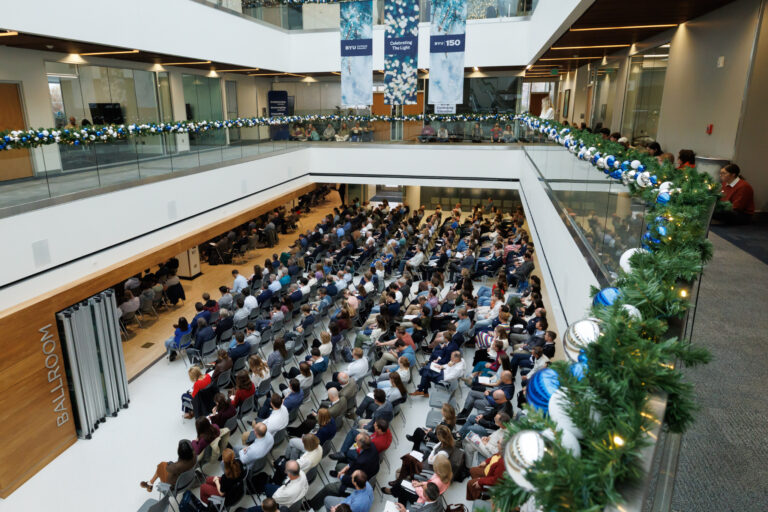
The keynote speaker was Elder Gerald Caussé, our newly called apostle. He spoke to hundreds attending both the Stewardship Symposium and the For the Benefit of the World conference, which focuses on caring for those in need. The room was packed, and students who couldn’t get in watched from the upper levels of the building.
Students overflow the room to hear Elder Caussé speak at the BYU Stewardship Symposium. Photo Courtesy of the Church of Jesus Christ of Latter-day Saints.
He also discussed the Church’s efforts to protect the Great Salt Lake. In September, the Church announced a 10-year lease of up to 7,400 acre-feet of water annually. “We acknowledge the numerous complexities surrounding the future of the Great Salt Lake and stand ready to be a part of the solution alongside all our diverse community stakeholders,” Elder Caussé said.
The rest of the symposium took place in the historic Maeser Building, where we heard from many devoted earth stewards on topics such as personal narratives and place; institutional stewardship practices; doctrine and theology; technology, science, and resilience; literature, humanities, and wonder; stewardship models; ethics, law, and policy; the environment and the arts; faith, ethics, and energy futures; behavioral and practical action; and systems and sustainability challenges.
One highlight for me was hearing from Jenica Sedgwick, the Church’s sustainability manager, about how seriously and carefully the Church approaches its stewardship decisions. It was humbling to hear Bill Rudy speak about his commitment to recycling and inspiring to hear Logan Millsap explain how he and his wife have chosen to live without a car as an act of community care. Ben Abbott raised our hopes about the Great Salt Lake and invited us to believe in our power to help restore it. Eva Witesman highlighted the deep connections between earth stewardship and the creation of Zion. Truly, every talk was inspiring and elevating.
Another highlight was simply being in the presence of so many incredible earth stewards and feeling the joy and hope that come from connection and from loving the earth. Thank you, BYU, for this wonderful symposium!
Lydia lives in Holladay, Utah, and loves exploring the intersections of spirituality, stewardship, teaching, and the arts. She is a host of the Holy Earth Podcast as well as a music teacher, composer, and performer.