
Stopping by the Duck Pond on a Snowy Evening
By Beck Seamons
Last year, I found myself constantly returning to a poem by Wendell Berry, “The Peace of Wild Things.” Originally published in his 1968 poetry collection, Openings, “The Peace of Wild Things” reflects on the use of nature as a balm for life’s stressors.
The Peace of Wild Things
When despair for the world grows in me
and I wake in the night at the least sound
in fear of what my life and my children’s lives may be,
I go and lie down where the wood drake
rests in his beauty on the water, and the great heron feeds.
I come into the peace of wild things
who do not tax their lives with forethought
of grief. I come into the presence of still water.
And I feel above me the day-blind stars
waiting with their light. For a time
I rest in the grace of the world, and am free.
At the time, several forms of uncertainty were converging. School felt relentless, my parents were in the process of a divorce, and graduation was approaching faster than I felt prepared for. Everyone around me seemed to know what came next – careers, plans, trajectories – while I felt frozen in an increasingly bleak limbo. The weight of these unknowns was uncomfortable.
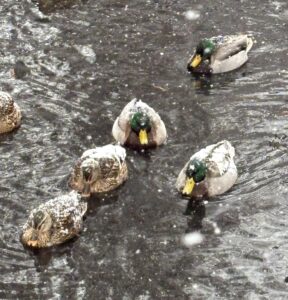
Most evenings, my walk home took me through the Harrison Arboretum on the south side of BYU campus. Campus would be mostly empty then, and the arboretum became a sanctuary. I started lingering there after long days of class, work, tests, and assignments. Sometimes I sat near the pond, watching ducks drift across the water or rest on the grass, unbothered by my presence. On other nights, I walked along the arboretum’s paths, pausing to watch deer feeding along the bushes and listen to the soft tug of their teeth on leaves. The awe I felt in the presence of such graceful creatures grounded me, and in those moments my worries about the future stopped existing.
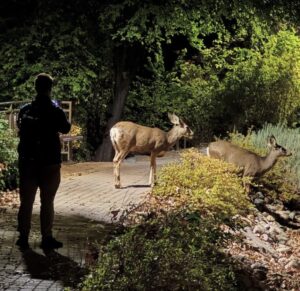
What struck me most was that these animals weren’t untouched by difficulty; in fact, their lives were dictated by much more uncertainty than mine! Winter was approaching, and food was not guaranteed. They spent their days navigating through busy roads, rugged terrain, and unforgiving weather. And yet, they moved through the world attending to only what was immediately before them: eating, resting, tending to each other. Their way of being felt profoundly different from my own restlessness and worry about the future.
Spending time with the deer and ducks that roam BYU campus, or with flora and fauna anywhere, I’ve learned that “the peace of wild things” is not found in the absence of threat or struggle, it is an attitude toward the world. The animals were participating in creation as it was, and focused on responding rather than resisting.
In Mosiah 24, the people of Alma are the victims of intense persecution and are restricted from practicing their faith. As they pray to Heavenly Father to deliver them from their burdens, He responds: “I will also ease the burdens which are put upon your shoulders, that even you cannot feel them upon your backs, even while you are in bondage” (Mosiah 24:14). Rather than eliminating their struggles, God helped the people of Alma find the strength to face their futures with confidence.
Those evenings at the Harrison Arboretum did not answer my questions about the future. Graduation still came and clarity didn’t arrive all at once. But those moments helped soften my relationship with uncertainty. Like the people of Alma, I was not delivered from difficulty so much as strengthened in it. Peace became less about knowing what would happen next and more about learning how to live attentively in the present. In a world that constantly urges us toward efficiency, speed, and control, I am grateful for the different perspectives that nature offers us. In trying to connect with wild things, I found moments of grace that sustained me when answers were slow to come.
Beck Seamons is a recent graduate of BYU and incoming master’s student at Georgetown University. A native of Draper, Utah, Beck is passionate about bicycles, classical music, Chinese, and spending time with friends.