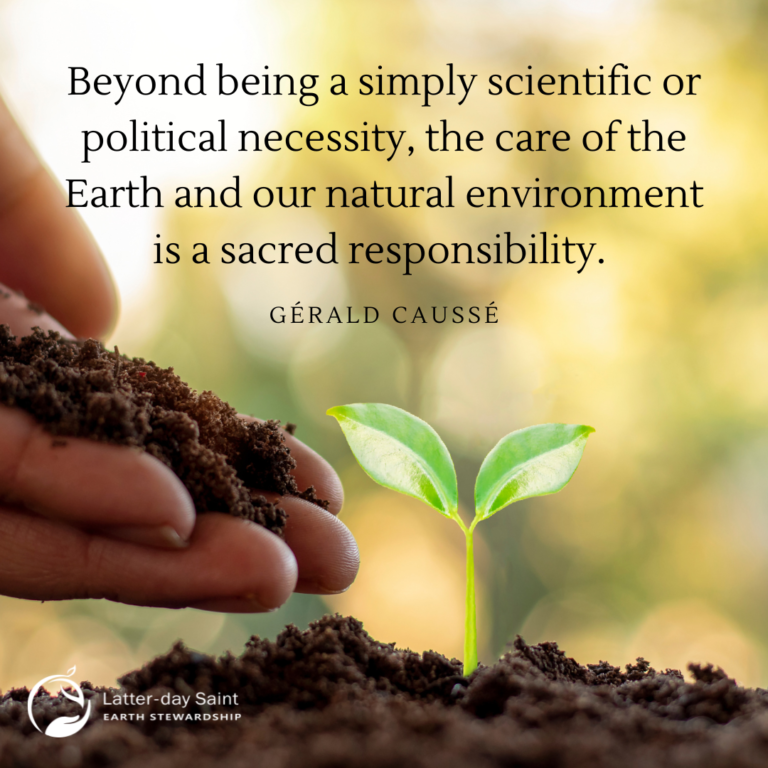
On or about April 22, people around the world will celebrate Earth Day, affirming the importance of caring for the natural world in all its marvelous beauty and complexity, protecting the air we breathe and the water we drink. Latter-day Saints will be among those celebrants because we know that caring for the earth is more than a practical necessity; we recognize that stewardship for the earth is a sacred assignment. People of good intent might disagree about specific laws or policies, but sorting through such disagreements is the messy business of politics in a heterogeneous society, and navigating such processes is part of our responsibility as well. Our strength and what unites us is a shared conviction that how we treat the Earth – the world we leave our children – is not just a temporal concern, but also a spiritual imperative.
This principle has been hiding in plain sight since the Restoration, but has been underscored in recent years through teachings of leaders such as President Russell M. Nelson, Presiding Bishop Gérald Caussé, (now Elder Caussé), and Relief Society General President Camille N. Johnson. These leaders have reminded us that caring for the Earth is part of our discipleship, and also that caring for the Earth goes hand-in-hand with caring for the people who live on the Earth. That aspect, (caring not just for the natural world, but also for our brothers and sisters with whom we share it), might feel overwhelmingly daunting. After all, if we’re still struggling to adequately care for the earth, how can we be expected to care for the earth and its people? Nevertheless, the teachings of these leaders are unambiguous; caring for the earth and its people are two sides of the same coin. To put it another way, true sustainability has many dimensions, including the human element.
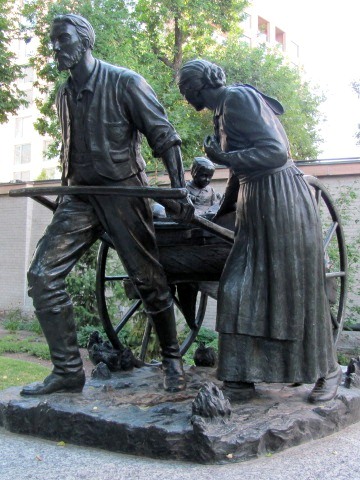
Fortunately, when faced with what seem to be overwhelming challenges, Latter-day Saints – like other people of faith – have an advantage. We are people of vision, and we are accustomed to working towards a better world, even when it seems impossibly distant. We persevere, even if we may not see the fruits of our labors in this lifetime. We are buoyed by the idea that “with God, all things are possible.” The handcart pioneers who walked to Zion probably did not fully apprehend what lay ahead. They faced great challenges, and some of them died along the way. But the end result was that they built a city where they would be safe from persecution.
The Handcart Pioneer Monument, by Torleif S. Knaphus, located on Temple Square in Salt Lake City, Utah.
Our journey of earth stewardship may be like that trek. I expect that fully realizing earth stewardship will entail challenges and solutions that we can not conceive today. It will require a foundation of the best science, along with creative innovation and broad societal change. It will require really listening to those with whom we do not see eye-to-eye. More difficult than we currently understand, with inevitable missteps, but ultimately restoring and protecting some of what indifference, shortsightedness and selfishness have so recklessly squandered. As Latter-day Saints, we are only one thread in a global tapestry of those who hold creation sacred, but we embrace our work with boldness, conviction, and joy.
Peter Ashcroft is the Vice Chair of Latter-day Saint Earth Stewardship. He’s a data scientist who currently lives in Salt Lake City with his wife, where he enjoys hiking, climbing, and other outdoor pursuits.